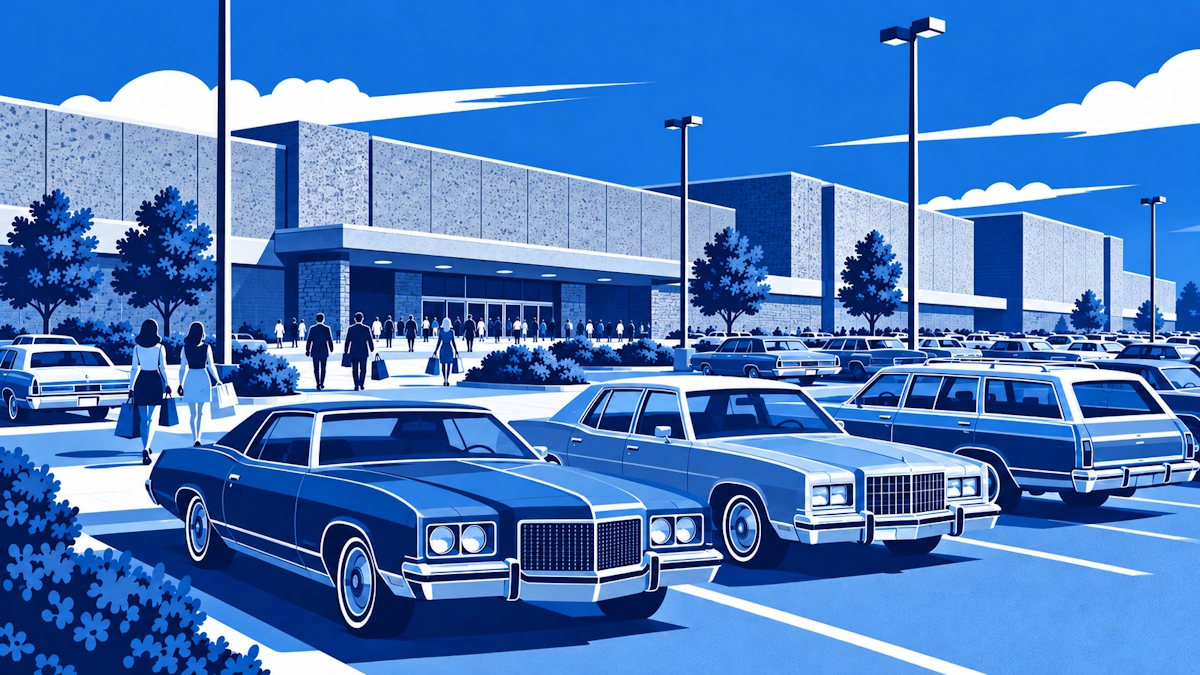
In Brooklyn Center, there was a mall.
Brookdale Center, also referred to as the Brookdale Mall.
It had neighbors, too.
Around the mall, shopping centers, restaurants, and a dealership formed a sprawling regional retail district.
You could shop for clothes, look at a Ford you probably weren’t going to buy—much to the disappointment of the salesman—catch a movie, and finish the afternoon comparing televisions.
All within the same shopping district.
The mall was the main attraction, of course. But the surrounding businesses made the area a sprawling destination where you could buy almost anything.
Then, over the years, familiar destinations became former destinations.
My interest in the area started in 2017, became one of my pandemic-era rabbit holes, and picked up again in 2024 as I became more interested in the history of retail and industry.
Brookdale is a fascinating case because so many of its old landmarks have disappeared. Yet the area hasn’t stopped being a place to shop.
How did a regional shopping destination lose so many of the places that originally defined it? What replaced them? And why have some of those properties proved so much easier to clear than to repurpose?
Before Brookdale
The story of Brookdale starts with Brooklyn Center itself.
Long before the shopping centers and subdivisions, it was Dakota homeland. European American settlement followed in the nineteenth century, and the area developed into a farming community.[1]
One prominent landowner was Earle Brown. His grandfather, Captain John Martin, sold him a farm in 1901, which Brown expanded to approximately 750 acres. In 1911, the meeting that established the Village of Brooklyn Center took place on his property.[2]
The community that could support a regional shopping mall emerged decades later.
After World War II, new neighborhoods spread across Brooklyn Center. The city places most of its neighborhood development between the 1950s and 1970s. By 1970, its population had reached more than 35,000.[3][4]
Much of that postwar landscape remains recognizable in the city’s neighborhoods of modest houses.
All these households needed places to shop. Highway 100 offered regional access, and the developing interstate network would eventually strengthen those connections, helping the district attract customers far beyond Brooklyn Center itself.
Dayton’s saw an opportunity.
Brookdale Is Born
In 1955, Dayton’s announced plans for a shopping center in Brooklyn Center. Its proposed name was Northdale.[5]
Southdale hadn’t even opened yet.
That came in 1956, when the Edina development introduced the nation’s first fully enclosed, climate-controlled shopping mall. By then, plans for its northern counterpart were already underway.[6]
Brookdale Center opened in 1962, with Sears and JCPenney anchoring its first phase. Although Dayton’s developed Brookdale, its own department store wasn’t part of the opening lineup. Dayton’s followed in 1966 during a later expansion, with rival Donaldson’s opening in 1967.[7]
Brookdale eventually became one of the Twin Cities’ familiar “Dales,” alongside Southdale, Rosedale, and Ridgedale.[7]
Over the following decades, the surrounding district gave shoppers more reasons to make the trip.
Across Bass Lake Road stood Brookdale Square, a separate shopping center whose tenants would include Circuit City. The surrounding complex also included the movie theater later known as Brookdale 8. Nearby, Brookdale Ford occupied the northeast corner of Bass Lake Road and Shingle Creek Parkway.[8][9]
Farther north, Target opened at 6100 Shingle Creek Parkway in 1986, adjoining the Shingle Creek Center strip mall.[10] Behind that shopping complex stood Brookview Plaza, at 5951 Earle Brown Drive, which would later house Brown College.[11][12] Across Earle Brown Drive stood Kmart, in the large building later subdivided for other retailers.[13][14]
You could buy clothes, compare stereos, catch a movie, shop for groceries, and look at a new car—all within the same district.
The mall was the centerpiece of a much larger shopping destination.
The Beginning of the End
Brookdale’s decline unfolded over decades. Competition grew, its surroundings changed, and keeping an aging mall competitive required investment.
Rosedale Center opened in 1969, followed by Northtown Mall in 1972. Mall of America arrived in Bloomington in 1992, offering shopping and entertainment on an enormous scale.[15][16][17] The Shoppes at Arbor Lakes opened in Maple Grove in 2003, adding another destination in the growing northwestern suburbs.[18]
But Brookdale had operated alongside other malls for years. Their opening dates alone cannot explain why it struggled.
By the early 1990s, there were documented signs of weakness. A 1994 filing by Brookdale’s owner reported that occupancy had been declining since 1992. It identified the recent recession and tenant bankruptcies as pressures on the business and warned that the decline could continue.[19]
Ownership and investment also deserve attention. In December 2009, retail consultant Jim McComb told the Star Tribune that Brookdale had suffered from years of inattentive ownership and insufficient investment.[20]
An aging mall needs maintenance, appealing spaces, and businesses that give people reasons to visit. As competitors offered newer alternatives, Brookdale’s owners faced the challenge of keeping an older property worth the trip.
Meanwhile, the geography of suburban shopping was shifting. Growth continued farther outward, giving retailers opportunities to build closer to new customers. A 1994 Minneapolis Federal Reserve article discussed precisely that possibility for the region’s department-store anchors.[21] Brookdale could lose its position in the regional market even without an existing customer moving away: new households could settle farther out and find their shopping needs met elsewhere.
Brooklyn Center itself was moving beyond its initial suburban boom. Between 1970 and 1990, its population fell from about 35,000 to 29,000—even as its number of households increased. Average household size dropped from 3.64 people to 2.56.[4]
Those figures are consistent with a familiar stage in a suburb’s life: children grow up and leave, while parents remain in homes that now hold fewer people. They do not establish that entire families were abandoning Brooklyn Center for Maple Grove or any other suburb.
Household finances were changing, too. A 2004 University of Minnesota study reported that the city’s poverty rate rose from 2.7 percent in 1970 to 7.1 percent in 1990, reaching 7.4 percent in 2000. The researchers also described declining household incomes, business departures, and difficulty attracting investment.[22]
Residents remained customers, but financial pressure could change what they bought, how often they shopped, and which stores fit their budgets. Counting people alone could not explain the market around Brookdale.
Nor did the population decline continue indefinitely. Census counts rose from 28,887 in 1990 to 29,172 in 2000, then to 30,104 in 2010.[23] Brookdale continued struggling even as the city added residents again.
Brooklyn Center was also becoming more culturally diverse. African American families moving from north Minneapolis, along with immigrants from Africa and Asia, helped reshape the community.[24] Changes in cultural background and household income were distinct developments; understanding customers required paying attention to both.
City residents represented only part of Brookdale’s regional customer base. But as newer destinations weakened its draw from farther away, its relationship with the surrounding community became an increasingly important question.
How well did Brookdale serve the people now making Brooklyn Center their home?
Later efforts reveal needs residents felt the broader district wasn’t meeting. In 2022, Hmong residents consulted about the Opportunity Site called for more culturally diverse restaurants and stores.[25] The following year, African immigrant entrepreneurs helped purchase Shingle Creek Center with plans to expand opportunities for small businesses.[26]
These developments came after Brookdale closed. They cannot establish what would have saved it, but they show people working to build businesses and destinations around the community’s needs.
Additionally, theft was becoming an increasing concern among retailers (note that this was not just a Brookdale problem). Historical accounts describe an early 1990’s program involving the mall and Brooklyn Center that offered first-time juvenile offenders an opportunity to apologize and potentially make restitution rather than enter the criminal justice system.[7]
Theft remained an issue into the mall’s final years. Police figures reported in January 2009 showed 556 thefts, mostly shoplifting, in 2007 and 523 in 2008.[27] These figures count reported incidents, which may capture only part of the theft occurring. How much went undetected at Brookdale is harder to establish. We know that theft was happening, but we don’t know how much was actually happening, and how exactly it influenced store closures or the mall’s eventual demise.
Finally, competition was moving beyond shopping centers altogether.
Amazon began selling books online in 1995.[28] Over the following decade, internet shopping gave customers another way to compare prices and buy merchandise without visiting a store. The Census Bureau estimated U.S. retail e-commerce sales at $134.9 billion in 2009.[29]
Brookdale’s troubles predated that shift, and national figures cannot tell us how much business it lost online. But internet retail added another competitor during its final years.
In the end, Brookdale was trying to recover while the conditions around it kept changing. New shopping districts competed for its regional customers. Local households had different needs and budgets. Its property required investment, and shopping increasingly required no trip anywhere.
The challenge was finding a reason for people to keep coming back.
A Turnaround That Didn’t Hold
There were efforts to change its fortunes.
A major renovation in 2001–2002 updated the mall and brought in tenants including Old Navy, Gap, and American Eagle. Brookdale wasn’t simply left untouched until someone arrived with a wrecking ball.[30]
But the recovery didn’t hold.
JCPenney’s departure cost Brookdale one of its original anchors. Its new Coon Rapids store was identified in a November 2003 trade report as one of the company’s tests of a modern off-mall format—a particularly clear example of retail investment moving both outward and away from the traditional enclosed mall. Mervyn’s closed its Brookdale location in 2004.[30][31]
Steve & Barry’s subsequently occupied part of the former JCPenney space, only to close amid that chain’s bankruptcy in 2008. Macy’s followed in 2009.[30][32]
(I remember in the early days of getting my driver’s license, my cousin and I drove up to Brookdale from St. Paul, a long journey when you’re a fresh driver, and went to the Steve & Barry’s. My cousin and I bought matching Duke jackets…for reasons that escape me today.)
Those departures had consequences beyond the empty department stores.
A mall’s businesses help generate customers for one another. When a major destination leaves, the smaller stores lose some of the traffic they depend on. As more stores close, there are fewer reasons to visit, making the remaining businesses harder to sustain.
Reinventing the property proved complicated, too. An earlier Walmart redevelopment proposal became entangled in litigation with Sears and was ultimately abandoned in that form.[33]
By the end of 2009, Brookdale was headed toward foreclosure after years of debt and tenant losses.[20]
Competition mattered. So did decisions by individual retailers, financial trouble, and the difficulty of rebuilding a viable tenant mix once the departures gathered momentum.
There wasn’t one moment when Brookdale died. Its decline unfolded through years of competition, business decisions, financial trouble, and accumulating vacancies.
Interesting History: Free Concert Ruckus
On November 12, 2005, Brookdale hosted a free Radio Disney concert featuring boy band B5. Roughly 2,000–2,500 fans showed up. Ten mall security guards were assigned to the event. That turned out to be insufficient.[32]
After the first song, fans rushed the stage, grabbing at the band members and tearing clothing. The performers retreated to safety, and approximately 70 police officers responded. Nine people reportedly suffered minor injuries. No arrests were made. The mall was cleared and temporarily closed, reopening that evening.[32]
The incident became a memorable chapter in Brookdale lore, though its role in the mall’s further decline is unproven. Towards the end, Brookdale had trouble getting people to show up…but clearly not that day.
The End of an Era
In 2010, the enclosed mall closed. Most of it was demolished the following year.[7][35]
Sears stayed open.
There is something almost absurd about taking down a shopping mall while one of its department stores continues doing business. According to demolition contractor Rachel Contracting, crews had to separate the mall from the operating Sears store by hand.[35]
The company also reports recycling more than 85 percent of the building material, with concrete and asphalt reused on the redevelopment site.[35]
Some of Brookdale quite literally became the foundation for what followed.
Across Bass Lake Road, other familiar properties were disappearing on their own timelines.
Demolition at the former Brookdale Ford site was photographed in 2008. City records describe additional soil corrections and final demolition work in 2016, including removal of floor lifts and an underground tank.[36][37]
Brookdale Square was also demolished in 2016, three years after the city bought the property for redevelopment.[38]
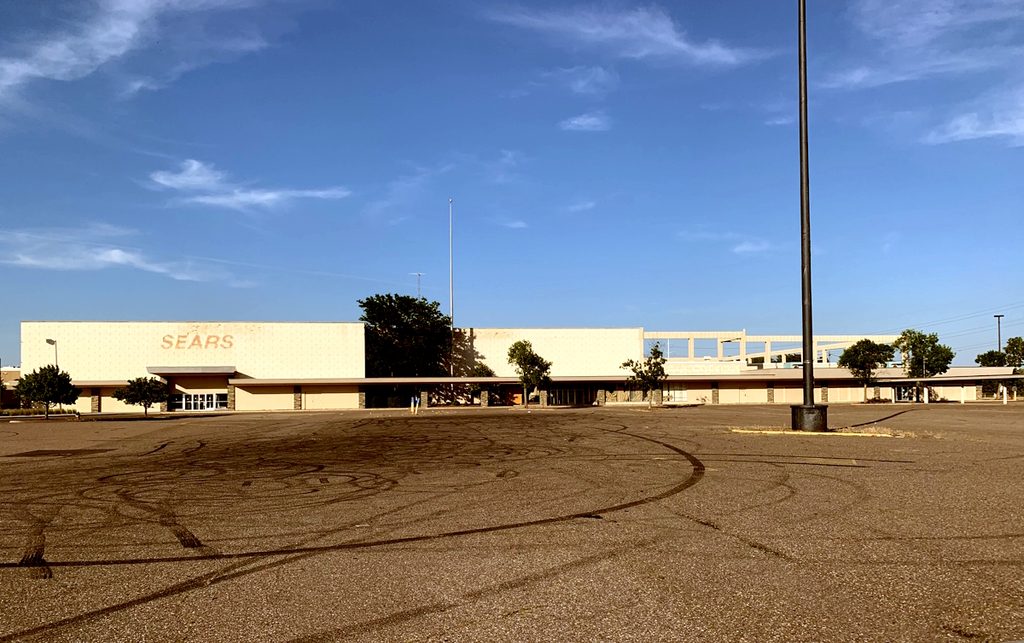
Sears finally closed in 2018. Target shut its doors in February 2019, ending more than three decades on Shingle Creek Parkway. Its vacant building was later demolished.[39][40][41]
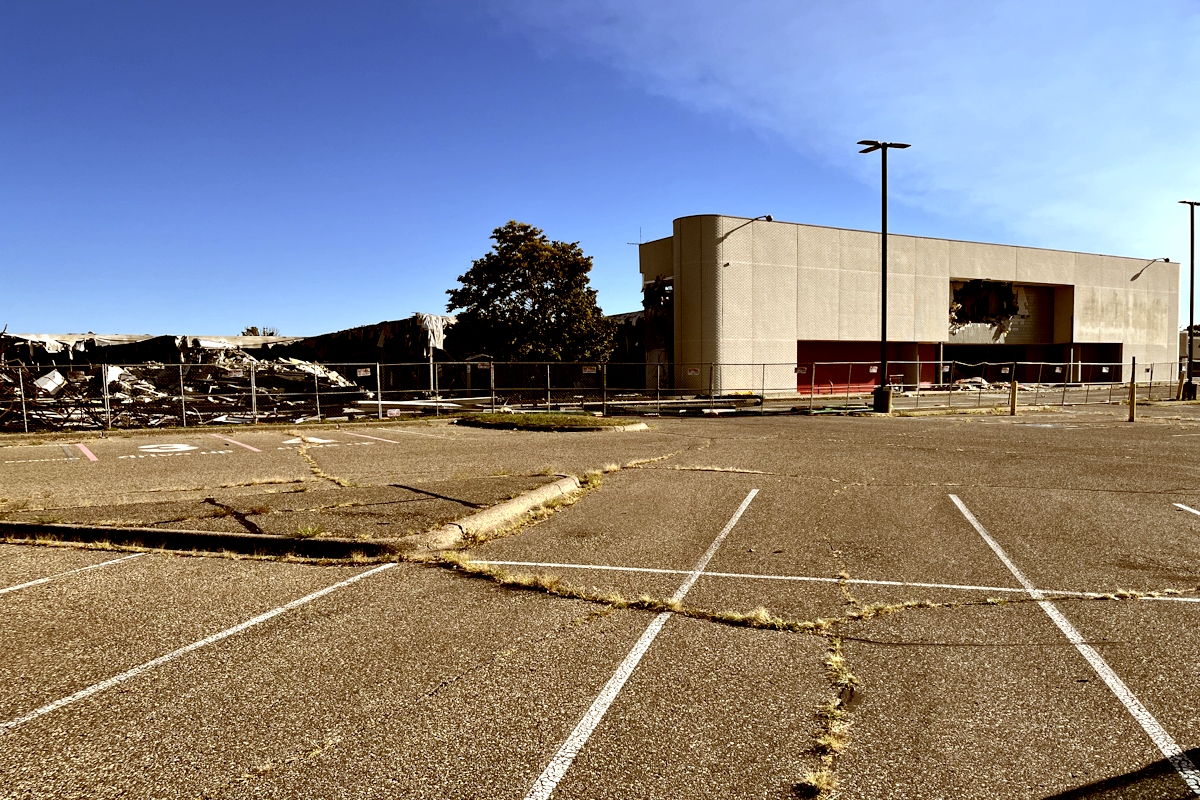
Dollar Tree now occupies part of the former Kmart building, a surviving retail presence on a largely vacant property.[13][42]
A store closed. A building sat empty. Eventually, demolition crews arrived.
You could still drive the same roads, but many of the places you once turned into were gone.
In With the New—and Another Loss
Back at the mall site, redevelopment was already underway.
Shingle Creek Crossing replaced most of the enclosed mall with an open-air shopping district. Its new Walmart opened in September 2012.[43]
You could still shop at Brookdale’s former location, but you couldn’t take the same walk through Brookdale.
The new arrangement had setbacks of its own. Kohl’s, which occupied a separate building beside the old mall, closed in 2014. Its former property was subsequently redeveloped for HOM Furniture.[44][45]
Then Walmart closed on April 21, 2023, a little over a decade after opening. The company attributed its decision to the location’s financial performance, saying several factors informed the closure.[46][47]
It was tempting to ask: if Walmart couldn’t make it here, who could?
The building’s next occupant offered a useful response. Empire Foods, connected through its ownership to Sun Foods, opened in the former Walmart in 2024.[48]
Walmart’s departure was a substantial loss. But it wasn’t the end of the building’s usefulness.
What’s Next?
That’s the multimillion-dollar question.
What will sustain the shopping district now? What happens to the abandoned Sears building? And when will something finally replace the stretches of pavement north of Bass Lake Road?
The old Brookdale Square and Ford dealership properties became part of Brooklyn Center’s larger Opportunity Site, an approximately 80-acre redevelopment area north of the former mall.[9][49]
Plans for that land have come and gone. In 2017, Finance & Commerce was already asking what had happened to Brookdale Square’s redevelopment after negotiations with prospective developers failed to produce a final agreement.[38]
In 2022, the city approved an approximately 16-acre first phase involving housing and community-serving uses.[9][49] By July 2026, another concept was being discussed: Novarum Development Partners proposed a mix of owner-occupied housing, retail, green space, and a waterway.[49][50]
The city’s longer-term ambition was a walkable downtown.
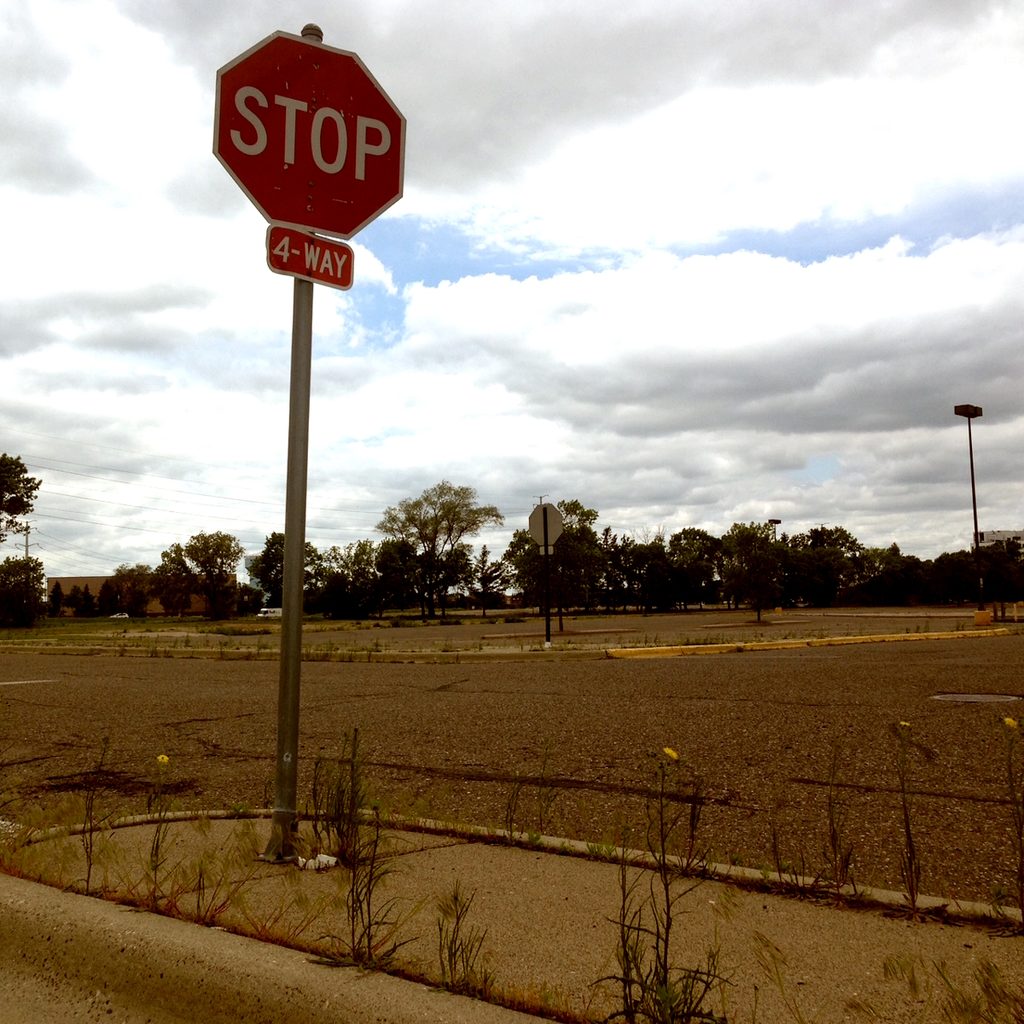
But plans and approvals haven’t yet produced that neighborhood. Across the vacant properties, weeds continue working through pavement that once carried shoppers and cars.
Housing and public spaces could help bring activity back. More residents could mean more customers for nearby businesses, while useful shops, services, and gathering places could make the area more attractive to live in. Making that work will require financing, construction, and places people can afford to use.
Brookdale’s next chapter will take shape under different circumstances from its earlier years. Whatever eventually fills those properties needs to give the people living nearby reasons to use them—and reasons to stay.
Reflecting Back on Brookdale
Using the old Sears building as a guide, you can begin to picture the mall’s former layout.
A little farther north, at the former Ford and Brookdale Square properties, remnants of pavement, curbs, and light poles offer clues.
If you’re just passing through, there might be little reason to give those remnants a second look.
But think about what happened across this district.
Parents Christmas shopping for their kids. Families navigating the mall with shopping bags and strollers. Teenagers wandering around with allowance money and nowhere else to be.
Someone getting their first job. A salesman making his first sale. A couple buying their first car. Coworkers starting to date—and perhaps eventually starting a family. Two people going to a movie together, wondering whether there would be a second date.
I don’t need everything to go back to the way it was. Although, given access to a time machine, I’d absolutely take a walk through Brookdale at its busiest.
What interests me is how thoroughly a place can change. A destination becomes familiar, then struggles, then disappears in pieces. People arriving later see a different place, without necessarily knowing what came before.
Many of the buildings that defined the old Brookdale are gone.
But there are still plenty of people who could tell you exactly what it was like.
Sources
Citation order and added evidence reviewed October 18, 2026. Redevelopment proposals are described as proposals, not completed projects. Some original sources require subscriptions or restrict automated access.
[1] City of Brooklyn Park: Our History — shared regional and Dakota history.
[3] Brooklyn Center: Community Profile and Demographics.
[5] Dayton’s historical overview — 1955 Northdale announcement.
[6] City of Edina: Southdale Center.
[7] Brookdale Center / Shingle Creek Crossing historical overview — opening phases and closure.
[8] SEC filing, 2004 — Brookdale Square and Circuit City.
[9] Brooklyn Center, August 8, 2022 redevelopment application — former uses, addresses, and boundaries.
[10] Star Tribune: Target to close Brooklyn Center store — 1986 opening.
[12] Minneapolis Northwest Tourism: Brown College — historical campus listing at 5951 Earle Brown Drive.
[15] City of Roseville: Community Pride—Roseville at 75.
[16] Anoka County Historical Society: A History of Retail in Blaine.
[17] Mall of America: History and Facts.
[18] Opus: Arbor Lakes Lifestyle Center.
[21] Federal Reserve Bank of Minneapolis, 1994: Local Shoppers Head to Mall of America.
[31] Home Textiles Today, November 10, 2003: JCPenney in Test of Smaller Off-Mall Unit.
[32] Finance & Commerce, January 9, 2009: Macy’s to Close in Brookdale.
[35] Rachel Contracting: Brookdale Mall Demolition.
[36] Dumpy Strip Malls, August 2008: Brookdale Ford — dated photographic observations of demolition.
[38] Finance & Commerce, May 29, 2017: Whatever Happened to Brookdale Square Redevelopment?.
[39] CCX Media, July 26, 2022: Developer Offers Plans to Redevelop Brooklyn Center Sears Site.
[40] CCX Media, October 30, 2018: Brooklyn Center Target to Close in February.
[42] Dollar Tree: Brooklyn Center store listing — 5930 Earle Brown Drive, Suite 100.
[43] Walmart, September 4, 2012: Brooklyn Center Store Opening.
[44] Star Tribune, March 24, 2017: HOM Furniture Will Remake Shuttered Kohl’s Store.
[45] Star Tribune, April 13, 2018: HOM Furniture Will Add Eighth Twin Cities Location.
[46] CCX Media, March 21, 2023: Brooklyn Center Walmart to Permanently Close April 21.
[47] MPR News, March 21, 2023: Walmart to Shutter Brooklyn Center Location.
[48] CCX Media, 2024: Empire Foods Opening at Former Walmart Site.
[49] Brooklyn Center: Opportunity Site.
[50] CCX Media, July 29, 2026: New Opportunity Site Concept.